
Physics of Light
Light: The Invisible Material of Photography
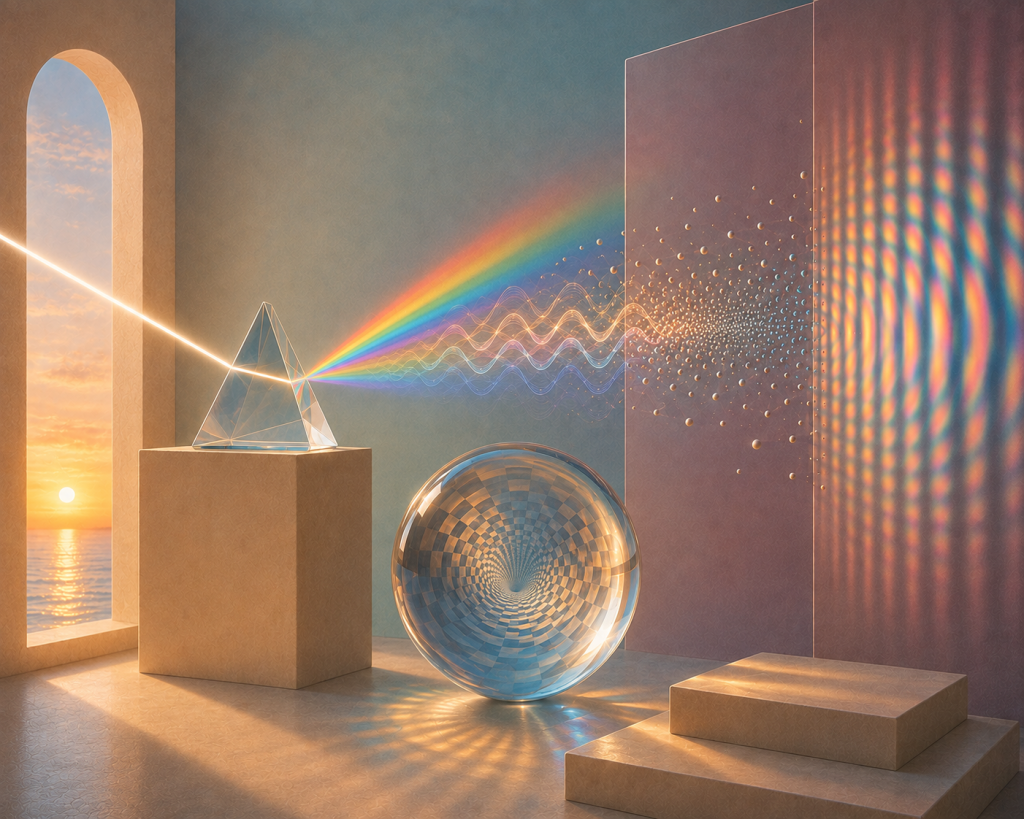
Light constitutes the primary material of photography, yet it rarely presents itself as the object of the image. It enables appearance while withdrawing behind what it renders visible. In the preceding discussion of beauty, illumination carried a philosophical meaning: Light disclosed what lay beyond appearance. In photography, this metaphor becomes physical fact. Light is simultaneously a condition of seeing and an ancient metaphor for understanding.
Visibility, however, is not a linear function of illumination. Both excess and deficiency negate form and texture — through erasure at one extreme and concealment at the other. The photographic image therefore emerges within a fragile interval in which light reveals without annihilating. Its quantity, direction, intensity, spectral composition, polarization, duration, and spatial distribution are consequently not merely technical parameters, but expressive conditions through which the conceptual and aesthetic intentions of an image become visible.
Yet physical light and perceived light are not identical. Human vision adapts chromatically and luminously, responds non-linearly to intensity, and interprets contrast contextually. The same physical distribution of light can therefore produce radically different perceptual outcomes according to its surroundings and the observer’s state of adaptation. Light must be calibrated not merely according to what reaches the eye or sensor, but according to how it will be seen, remembered, and interpreted. Color reflects Johann Wolfgang von Goethe’s view that color is an emergent perceptual phenomenon arising from spectral illumination, material reflectance, sensor response, and perceptual reconstruction, rather than a simple intrinsic property residing in objects. Photographic color is therefore an interpretive act rather than a neutral transcription, negotiated between world, apparatus, and observer.
The physical nature of light deepens this complexity. Light resists reduction to a single classical description. Electromagnetic field theory describes propagation, reflection, refraction, dispersion, diffraction, interference, and polarization with extraordinary precision, while quantum electrodynamics describes light–matter interactions in terms of quantized excitations and discrete exchanges of energy. The familiar language of wave–particle duality expresses this conceptual tension, although modern physics does not regard light as simply alternating between a classical wave and a classical particle. Different experimental conditions disclose different aspects of a physical reality that neither classical picture alone exhausts.
These properties have direct photographic consequences. Reflection determines how surfaces return light; refraction enables the lens to form an image; dispersion separates wavelengths and gives the rainbow its chromatic order; diffraction places fundamental constraints upon optical resolution; and interference becomes visible in phenomena such as thin films. Polarization introduces another dimension of structure: The orientation of the electromagnetic field influences reflections, glare, and the legibility of surfaces, allowing the photographer to reveal information otherwise concealed by reflected light. Coherence, phase relationships, and spectral bandwidth further govern the interaction of light with matter and optical systems, becoming especially consequential in interference-based, coherent, and specialized imaging.
At the level of detection, photography becomes explicitly quantum. Whether the photosensitive medium is a silver-halide crystal or a semiconductor pixel, image formation ultimately depends upon quantized interactions between light and matter. In electronic sensors, absorbed photons can generate mobile charge carriers that are subsequently collected and measured; in photographic emulsions, photon absorption initiates the photochemical processes from which the latent image develops. Because photon detection is discrete and statistical, the apparently continuous photograph emerges from innumerable microscopic events whose probabilistic character contributes fundamental limits to signal-to-noise performance, sensitivity, and dynamic range — particularly under scarce illumination.
Beyond conventional photographic conditions, nonlinear optics reveals still more complex forms of light–matter interaction. Multiphoton absorption, fluorescence-related processes, frequency conversion, and harmonic generation demonstrate that matter need not respond proportionally to the electromagnetic field. Such phenomena become important in specialized scientific imaging, microscopy, spectroscopy, and advanced optical technologies. They belong to the same broader physical universe upon which photography rests, even when their effects remain negligible in ordinary photographic practice.
Light holds a unique position in Albert Einstein’s Special Relativity, where photons lack a physical rest frame. So it is misleading to speak literally of what a photon “experiences.” Yet along a lightlike trajectory the proper-time interval is zero. Emission and absorption may be separated for an observer by distances and durations, while ordinary elapsed proper time cannot be assigned along the null path itself. The phenomenon through which photography records time thus possesses, at the relativistic level, an exceptional relationship to time of its own.
Photography can consequently be understood as a chain of manifestation:
Reality → Light → Image → Observer
Light mediates between material reality and photographic appearance. Yet the photographer does not remain passive within this chain. The process becomes consciously reciprocal: Light is received → Structure is understood → Light is orchestrated → Structure is revealed.
The photographer reads how illumination articulates form, surface, depth, movement, atmosphere, and meaning, and then reorganizes light so that the intended structure becomes maximally perceptible.
Photography therefore rests upon a remarkable physical and aesthetic paradox: Visible continuity emerges from discrete interactions; permanence is inscribed through transient events; and material reality becomes image through a phenomenon inseparable from matter, perception, space, and time. Light is more than photography’s means of illumination. It is the mediator between world and image, matter and perception, event and representation — and ultimately between what exists and what can be made visible.